
Letters from Father
Hell without Jesus
Hell without Jesus- December 27, 2024
Dear Brothers and Sisters in Christ,
Without Jesus, life is hell!
This weekend we celebrate The Holy Family. It is easy for us to forget that the Holy Family of Joseph, Mary, and Jesus was a real family. We have all seen paintings and holy cards that depict them in a super-pious, unrealistic, sometimes surrealistic, way. But they were real human beings, just like us, and they lived in the real world, the fallen world, just like us. The fact that Mary and Jesus were unaffected by original sin and that Joseph was a saint doesn't change the reality of their family life and their struggles.
In the Gospel this weekend we hear about Joseph and Mary losing their greatest gift, Jesus himself. We can only imagine Mary and Joseph's conversation when, at the end of a day's journey away from the temple, they realized that Jesus was not with their caravan. That's when the "great anxiety" (Lk. 2:48) clamped down on their hearts.
Great anxiety is putting it lightly. The Greek word odynomenoi is also found in Luke 16 to describe the fires of hell that the rich man is experiencing and pleads for Lazarus to alleviate his pain. So, Mary and Joseph were experiencing a living hell at the loss of Jesus.
Brothers and sisters, I encourage you to invite Jesus into your families by praying together each day as a family this new year. In this Jubilee Year, may we have the joy of welcoming Jesus deeper into our families. If not, 2025 will be a living hell.
In His Mercy,
Fr. Eric Clark, Pastor
Christmas Peace
St. Lucy- December 20, 2024
St. Lucy
St. Lucy- December 13, 2024
Dear Brothers and Sisters in Christ,
When I was twelve years old I helped my dad and hired hand weld sucker rod fence for some new cattle pens. My dad told me not to look at the welding arch but I still did because of the beautifully radiant color it emitted. Later that night, I woke up with pain in my eyes and could not see for two days. I stayed in a dark room on my back with shredded potatoes over my eyes which worked for the pain.
Losing one’s ability to see is devastating because our eyes are the greatest sense organ we have to come to know things of this world. Two things are essential for seeing an object; the eye and the medium of light.
Today is the feast day of St. Lucy, the patron saint of eyes. She was a young virgin martyr from Sicily who was put to death in 304 AD for the faith. Her name, Lucia in Italian, is believed to be derived from the Latin Lux, a term for “light.” St. Lucy’s legend holds that her eyes were gauged out and God then provided her with new eyes. This came about, it is said, because her pagan suitor loved her beautiful eyes. In some versions of this story, St. Lucy plucked out her eyes herself and gave them to her suitor; in other versions, her eyes were removed by her persecutors. St. Lucy is often depicted holding a small plate with two eyes on it. She is the patron saint of the blind.
In Dante’s Purgatorio, Lucy carries a sleeping Dante to the entrance to purgatory. Since Lucy represents light she carries him out of darkness. She carries him both out of the literal darkness to a new day, as well as the figurative darkness to lead him to salvation.
During this dark time of year may the light of the Christ illuminate our path and may the hands of His mercy heal the eyes of our soul so that we may run to meet Him when He comes this Christmas.
In His Mercy,
Fr. Eric Clark, Pastor
PS – I look forward to seeing your Sunday-best ‘pink’ this weekend!
St. Nicholas
St. Nicholas- December 8, 2024
Dear Brothers and Sisters in Christ,
|
An old man went to bed sad one night. There is no worse feeling for a father than being powerless to protect his children and give them a good life. And it seemed as though he had failed in this regard. It had been a hard year, and he and his daughters barely had enough money to live on from day to day. There was no way he could provide a dowry for them. Without that, they couldn’t marry and faced a life of slavery. His daughters were afraid, too, but tried to be hopeful. They spoke words of comfort to each other as they did their evening chores. “Maybe something good would come along, maybe a miracle would happen,” they said. Scrubbing their stockings clean as best they could, they hung them up by the window to dry near the dying fire. Then they went to bed. The next morning, the daughters went to collect their stockings. But as they approached the window where they hung, what did they see? The stockings were stretched out of shape, with a lump of something in the toes. They quickly investigated, and nearly cried for joy when they found gold coins in each one—more than enough to pay a good dowry. They ran to tell their father, and all four gave thanks to God. Indeed, a miracle had happened. God’s agent that night had been a clever and generous soul named Nicholas. He had heard of the father’s plight and, wishing to spare the father the shame of accepting charity, had snuck to the window during the night and tossed the money inside, where it had landed inside the girls’ stockings. Nicholas had saved the day—and started a tradition. This legend of the Christmas stockings is one of the most famous stories handed down to us about St. Nicholas, the 4th-century bishop of Myra in modern-day Turkey. Appearing under various regional titles— “Father Christmas” in Great Britain, “Sinterklaas” in the Netherlands, or “Papa Noël” in France—good St. Nicholas has become the symbol of generosity everywhere Christmas is celebrated. |
In His Mercy,
Fr. Eric Clark, Pastor
PS – Please join us for a St. Nicholas celebration and open house in our school after each weekend Mass.
First Week of Advent
First Week of Advent- December 1, 2024
Dear Brothers and Sisters in Christ,
We just finished celebrating one of my favorite national holidays, Thanksgiving. This day is filled with the three F’s: family, football and food comas. Hopefully by the time you’re reading this the tryptophan in your belly has worn off and you are awake again.
Jesus tells His followers in the Gospel this weekend to “Beware that your hearts do not become drowsy from carousing and drunkenness and the anxieties of life, and that day catch you by surprise like a trap.” (Luke 21:34)
Advent is like coffee for the soul, to awaken the drowsy soul. The Church gives us the season of Advent as a time to prepare for the coming of Christ. In reality, the time of His coming is always now.
One way to prepare for the coming of our Lord this Advent is by joining us at St. Peter Church for Stations of the Nativity this coming Friday (December 6th) at 2:30PM and 6PM. Each station takes an event from the early life of Jesus from the Gospel, its Old Testament prophecy and a reflection from a saint.
May we be awake this Advent so as to not miss His coming.
In His Mercy,
Fr. Eric Clark, Pastor
PS – Click here to see the St. Peter Christmas Wish list.
Sacred Music
Sacred Music- November 22, 2024
Veteran's Day
Veteran's Day- November 15, 2024
Death
Death - November 8, 2024
Dear Brothers and Sisters in Christ,
As the leaves on the trees begin to fall and the crops of the fields are harvested, we are reminded that November is the month to remember the dead. The great American philosopher, Peter Kreeft once wrote, “Death is our one certainty in an age of skepticism, our one absolute in an age of relativism, our one inescapable brush with other-worldliness in an age of this-worldliness, our last link with the sacred in an age of secularism. To secularize death, as our culture is doing, is the last blasphemy.”
There are a few ways in which we can honor our loved ones who have entered into eternity. The first is to visit the cemetery. Our modern world has blasphemed the sacredness of death and one example of that is to view cemeteries as places of horror and fear. Outside of visiting a Catholic Church in which Jesus is present in the tabernacle, the cemetery is the holiest place on earth. Our Christian hope tells us some who are laid to rest are saints in heaven who are seeing God face to face.
Finally, we should also contemplate our own death for we “are dust and to dust we shall return” (Genesis 3:19). Contrary to some popular sentiments, one does not become an angel when we die. When we die, we do not cease being human. Once we die, we will be judged on our love of God and love of neighbor (Matthew 22:37-39). We will receive one of the following judgements. Eternal punishment for our sins in the unquenchable fires of hell (Mark 9:43-45), the cleansing of our small sins in purgatory (1 Corinthians 3:11-15) before we enter heaven, or directly to paradise with Jesus (Luke 22:43).
May all the faithfully departed, through the mercy of Christ, rest in peace.
In His Mercy,
Fr. Eric Clark, Pastor
PS – Please join us this Tuesday at 7pm for Memento Mori-- A free event to plan and prepare Catholic funerals and estates.
All Saints Day
All Saints Day - November 1, 2024
Dear Brothers and Sisters in Christ,
Today we celebrate All Saints Day. This feast day has been commemorated in the Church since the 4th century to honor all the unknown saints who were martyred in the first three centuries of the Church. In time they are unknown to us but in eternity they are known to each other.
When St. Augustine read the life of these martyrs he said, “If all these people have achieved sanctity, then why not I?” He followed their model of living a life for God and others and became one of the greatest saints in the Church.
I encourage you to read the life of the saints. Pope Benedict XVI put it: "The example of the Saints encourages us to follow in their same footsteps and to experience the joy of those who trust in God, for the one true cause of sorrow and unhappiness for men and women is to live far from him"
All of us who follow Christ are called to be saints. So, what about you? What are you going to be the patron saint of? The city of Lincoln is still up for grabs or Nebraska or cattle-feeders (but I am shooting for that one).
Heaven is an eternal Halloween party and you already have your costume…. your baptismal garment. The question is, ‘what will be your accessories’? Will it be the lily of purity, the sword of truth, or the crown of martyrdom?
May one day, the feast day of All Saints be ours in eternity!
In His Mercy,
Fr. Eric Clark, Pastor
PS – Please join us for our Holy Day Mass today at 6:30AM; 8:15AM or 5:30PM.
Spiritual Blindness
Spiritual Blindness - October 27, 2024
The North American Martyrs
The North American Martyrs - October 18, 2024
Dear Brothers and Sisters in Christ,
A few weeks ago, over twenty parishioners and I had the amazing experience of following in the footsteps of the Canadian saints – St. Andre Bessette, St. Maria of the Incarnation, St. Francis Laval, St. Marguerite Bourgeoys, St. Anne de Beaupre and St. Kateri Tekakwitha.
But before we sang O Canada on the bus as we crossed into foreign land, we started in Amsterdam, New York where we toured the North American Martyrs shrine. Although rustic and screaming 1965 architecture, I found this place to be spiritually moving. Not because of the beauty of the Church (like Notre Dame in Montreal) nor the 17th century stone buildings of historic Quebec City, but rather because of the witness to the love of Christ of Saints. Isaac Jogues, Rene Goupil, and John de Lalande.
On Saturday we celebrate the feast day of the North American Martyrs. The three that died in upstate New York were the first to die for the faith in our country (1642-1646). Although they were very educated and came from French nobility, they were heroic in the faith under the most extreme conditions. They traversed for years in inclement weather, diseases, rough terrain and being hunted by Mohawk war tribes.
To put things in perspective of their courage and magnanimity, it would be like the Nebraska pork producers funding your missionary efforts to Israel but not stopping there. Once the Jewish people taste the goodness of Jesus Christ, His Church and beacon, you are sent to convert Hezbollah in the midst of them fighting with Israel knowing that you will probably die. This is exactly what the North American Martyrs signed up for.
To often we picture the North American Martyrs in long black robes (as the Natives American called them). But Saints Rene Goupil and John de Lalande were actually lay evangelists known as donne who helped the Jesuit priests further the Kingdom of God.
Although you may not be called to the Middle East to make converts for Christ or be martyred, you are still commissioned to proclaim the Kingdom of God and help your parish priest make converts. Jesus told us that we are the leaven of society to make it raise to God (Matthew 13:33). My hope and prayer is you find the courage to proclaim His Kingdom to all you meet just like the North American Martyrs.
In His Mercy,
Fr. Eric Clark, Pastor
Challenge of Love
Challenge of Love - October 11, 2024
Dear Brothers and Sisters in Christ,
What is the one thing that keeps you from following the Lord more closely? We all want greatness but too few of us are willing to pay the price.
In the case of this rich young man in the Gospel this weekend, the thing that was holding him back from the truly meaningful life he desired was his attachment to money and wealth. Jesus challenges the would-be-follower of the Messiah by asking him to give his possessions away in order to follow Jesus more closely.
As a good coach, teacher or parent know, to challenge someone to greatness is done with love because they see the potential in the person they are leading. They want to meet us where we are at but love us too much to leave us there. Saints are made by being challenged, sinners walk away sad.
But the challenge of Christ is always accompanied by His gaze of love. “Jesus, looking at him, loved him and said to him “You are lacking in one thing. Go, sell what you have, and give to the poor and you will have treasure in heaven; then come, follow me” (Mark 21). This was an appeal of love, not anger. It was a challenge of generosity to pull the man out of his own comfort into the adventure of following Christ. It was a gaze of grief of seeing a man deliberately choose not to be what he might have been and had it in him to be.
As Jesus gaze of love comes upon you today, what is the one thing that keeps you from Him? I challenge you to take that one thing to the sacrament of confession this week.
In His Mercy,
Fr. Eric Clark, Pastor
PS – confession times are:
Mon - 7:00-8:00am
Wed - 4:30-5:30pm
Fri - 7:00-8:00am
Saturday - 3:00-4:00pm
Sunday - 30 minutes before each Mass
Pro-life
Voting Pro-Life - October 4, 2024
Dear Brothers and Sisters in Christ,
Being less than a month away from re-naming our parish hall in honor of St. John Paul II, I have been reflecting a lot on his life. There are countless iconic images of this saintly Vicar of Christ. I recall one image of him celebrating Mass at the Lateran. Holding the Eucharist and gazing lovingly at Jesus, JPII is quietly sobbing. Kneeling in adoration, JPII placed his hand on his forehead, weeping inconsolably. This is my favorite image. We see JPII’s unconditional love of the Eucharist, his pastoral charity for the Church (saints and sinners), and contrition for all sin.
This November as Catholics, we have the duty to participate and make our voices heard in the General Election. As Catholics, it is our duty to vote. Voting is one of the most powerful ways we proclaim the Gospel by making our beliefs heard no matter how broken our political system/candidates are. Conscience is NOT simply our personal opinions or feelings but the power of man’s God-given intellect in judging the rightness or wrongness of moral actions based on Natural Law and the Ten Commandments. With an upright conscience, we cannot follow the initiatives of civil authorities when they are contrary to the demands of the moral order, to the fundamental rights of human persons, or the teachings of the Gospel. JPII fought for all this.
Initiative 439 is a masterfully wicked plot of the Enemy. It is broad, incredibly vague, and full of guile and deception. The same deceiver in the Garden is now trying to deceive us into another Original Sin: To enshrine abortion as a fundamental right in Nebraska as a “good fruit.” This is a rotten fruit not representative of the Good Life. Initiative 439 allows all persons (women, men, minors, etc.) to obtain an abortion without parental consent or knowledge, takes more tax dollars to support abortion, and enables babies to be aborted into the second and third trimesters based on the dangerous terms “fetal viability” and “professional judgment of health care practitioners.” Such language further enables moral relativism: The one with most power wins.
Why vote for 434? While 434 will keep the 12 week abortion ban in place as it currently stands, it is crucial to note that 434 does NOT directly will abortion but protection for ALL life. Morally, 434 is an initiative that uses a gradualist approach, wholly seeking to protect as many children as possible and working to eradicate abortion, even in medical emergencies and in cases of rape/incest. Moreover, the passing of 434 will safeguard the 50 year health/safety protections and make getting an initiative like 439 on the ballot again very difficult. If both initiatives get enough votes, the initiative with more votes wins. Therefore, it is crucial that we do everything in our power to withstand the great millstone of 439 by prayer, fasting, and voting. St. John Paul II, fearless champion of life and defender of the dignity of all human persons, pray for us!
In His Mercy,
Fr. Brian Wirth, Assistant Pastor
St. Vincent De Paul
St. Vincent De Paul - September 27, 2024
Dear Brothers and Sisters in Christ,
We may be familiar with the St Vincent de Paul Society, but fewer of us are aware of St Vincent de Paul himself - a man who swept through seventeenth-century France like a tornado of holiness. During one of his many visits to the galley slaves in the French city of Marseilles, he met one man who seemed sadder than all the rest. Galley slaves were criminals condemned to serve their punishment by forced labor as rowers on board ships.
"My friend," St Vincent asked the man, "what makes you so sad?"
"I have a wife and family far away," the slave replied, "and my heart aches to see them. But it will be a long time before I have that happiness - if I ever do."
St Vincent went to the overseer and asked permission to take the poor man's place. Not recognizing the saint, the overseer agreed. The chains were taken off the slave and put on St Vincent, who was forced to work in the place of the man he befriended. A short time later, however, when it was discovered who he was, the saint was set free. But the love and generosity of this heart had already breathed new life and hope into all the wretched men who were condemned to cruel labor at the oars.
I have said many times, that the two greatest organizations in the Church are St. Vincent de Paul Society and Legion of Mary because their deep spiritual life and work outside the walls of the parish. St. Vincent de Paul Society fulfills the mission to do corporal works of mercy and likewise Legion of Mary does the spiritual works of mercy. Please consider joining these great organizations.
May God bless and protect the associates of the St. Vincent de Paul apostolate.
In His Mercy,
Fr. Eric Clark, Pastor
PS – Click here below to check out St. Vincent de Paul Society
Korean Martyrs
Korean Martyrs - September 22, 2024
Dear Brothers and Sisters in Christ,
Twenty years ago, when I was on campus at North Dakota State University, an atheist doctoral student named EunSu Lee from South Korea told me that he wanted to be baptized and become Catholic because he told his ex-girlfriend that he would look into the faith. My first thought was “I would never follow through on a promise I made to an old girlfriend,” but I was shocked and edified at his sincerity and quest for pursuing the truth of Christianity.
EunSu joined a bible study and he was welcomed into the family of God through the waters of baptism at the Easter Vigil in the spring of 2005. Eventually he would bring many Korean exchange students to St. Paul Newman Center and several others converted to Christianity.
Today is the feast day of St Andrew Kim and companions. For about seventy-five years between 1791-1866, nearly 10,000 Christians were martyred for the faith in Korea and 103 of them have been canonized. St. Andrew Kim’s final words were, “It is for God that I die. My immortal life is on the point of beginning. Become Christians if you wish to be happy after death, because God has eternal chastisements in store for those who have refused to know Him.”
If you desire eternal happiness after death, I encourage you to continue your quest for knowing the Lord. One simple way to grow in your understanding of the faith is to subscribe to FORMED, in which our parish provides free for you. To access, simply...
- Click the button below to get started online
- Enter the Church zip code: 68516
- Select St. Peter
- Enter your name and email
May our witness of the faith draw others to the wellsprings of eternal life just like my friend EunSu Lee and the Korean Martyrs.
In His Mercy,
Fr. Eric Clark, Pastor
PS – I hope to see you all at the Fall Festival this Sunday from 1-3 PM.
St. John Chrysostom
St. John Chrysostom
Dear Brothers and Sisters in Christ,
Today is the feast of St John Chrysostom who was a 4th century Patriarch of Constantinople, the city where the Roman Emperor resided. St John was famous for his preaching, and has ever since been the Church's patron of preachers. Chrysostom is not his last name but rather nickname which means “Golden Mouth”.
But not everyone liked his homilies. One Emperor in particular threatened to exile the Patriarch if he didn't tone down his criticism of certain popular sins. The saint answered, "You cannot exile me, because the whole world is my Father's house."
To the threat of death, the saint replied, "You cannot kill me, because my life is hidden with Christ in God."
When the Emperor threatened to take away all his money, he answered, "My treasure is in heaven and my heart is there."
Finally, the Emperor said he would take away all the saint's friends. To that, St John responded, "You cannot do that either, because I have a Friend in heaven from whom you cannot separate me. I will not stop preaching the Gospel. There is nothing you can do to hurt me."
This is the type of courage we need if we want to be the kind of Christians who follow Christ faithfully in an anti-Christian world that tries to water down the Gospel.
In our 2nd reading this weekend we hear St. James proclaim boldly, “Faith without works is dead” (James 2:17). Our greatest work as a Christian is to have the courage to proclaim the goodness of Jesus Christ to all we meet so that one day, we may reside in paradise with St. John Chrysostom and all the saints in glory.
In His Mercy,
Fr. Eric Clark, Pastor
PS – Please join me at our upcoming Parish Fall Festival on September 22!
Be Open to The Way
Be Open to The Way
Dear Brothers and Sisters in Christ,
At the heart of the Gospel this weekend there is a small but, very important word; a word that in its deepest meaning sums up the whole message and the whole work of Christ. The Evangelist Mark writes it in the same language that Jesus pronounced it in, so that it is even more alive to us. This word is "Ephphatha," which means, "be opened."
This man in the Gospel trusted that either Jesus could heal him or his friends’ word to go to Jesus. He was open to encountering the Christ. Openness (after trust) is the second step to becoming a disciple of Jesus. Maybe you know someone in your life that is open to becoming a disciple and joining His Church. Or maybe you have had a recent conversion and are open to learning more about that faith. Or maybe you are Catholic and have never been received the sacrament of confirmation. If so, I invite you and anyone you know who is non-Catholic to join us for The Way.
The Way is the set of formation classes and community building events in which one prepares to become Catholic or rediscover the truth, goodness, and beauty of the Catholic Faith. The Way encompasses the Order of Christian Initiation for Adults or OCIA (formerly called RCIA or Rite of Christian Initiation for Adults). Classes will begin on Thursday, Sept. 12, 2024 from 7 to 8:15 pm. The first classes will include a series of group conversations to explore faith and life's big questions. You're invited, no matter your background or beliefs.
Jesus became man so that man, made inwardly deaf and mute by sin, would become able to hear the voice of God, the voice of love speaking to man’s heart. In God’s voice, man learns to speak in the language of love, to communicate with God and with others. It is for this reason, the word and the gesture of '"Ephphatha" are included in the Rite of Baptism as one of the signs that explain its meaning. “The Lord Jesus made the deaf hear and the mute speak. May he soon touch your ears to receive His word, and your mouth to proclaim His faith, to the praise and glory of God the Father.”
In His Mercy,
Fr. Eric Clark, Pastor
PS – to sign up for The Way please click here.
Doers of the Word
Doers of the Word
Dear Brothers and Sisters in Christ,
It was the early fall of 1993 when a young boy named Jason became excited at Mass. Afterwards, he asked his mom, “Why did the reader today during Mass say our last name?” Mary Doher, mother of Father Doher (our former assistant pastor) just laughed.
The second reading from the letter of James this weekend states, “Be doers of the word and not hearers only” (James 1:22). Doer is not just a surname. Doing is an act of love, and love always goes outside of our self to serve God and others.
To be a doer of the word, we need to become disciples of Christ. We don’t just come to Mass to be “hearers” of the word. We come to Mass to be filled with God’s love and give back to Him of our time, talent and treasures. So, we ask each household to fill out the discipleship commitment card you received in the mail.
And if we approach our day-to-day moments with being good disciples in mind, then we begin to see just how many blessings God has given us. Looking at life through the lens of gratitude helps us to see each moment as a gift with endless opportunities to respond in love by doing.
This is how we ought to live our lives as Christian disciples—by recognizing our lives as a gift and an opportunity to love God in response to how He has loved us.
So, let us look inward at our hearts and ask ourselves why we live our faith the way we do. Let us recommit ourselves to being good disciples by coming to Eucharistic adoration, attending Mass with attention, serving others out of love for God, and recognize just how blessed we are. It is in these simple moments that we love extraordinarily and honor God wholeheartedly.
Jesus Christ wants the heart of sinners, not the words of hypocrites. Today, let us give Him our heart.
In His Mercy,
Fr. Eric Clark, Pastor
Discipleship Hard?
Discipleship is Hard
Dear Brothers and Sisters in Christ,
A few years ago, there was a movie entitled “A League of Their Own” starring Geena Davis and Tom Hanks. Geena Davis’s character Dottie decides to leave the all-girl baseball team and tells her coach (Tom Hanks), “It just got too hard.” To which he responded, “It is supposed to be hard. If it was not hard, everyone would do it. The hard is what makes it great.”
What was hard for the followers of Jesus? They doubted in His teaching on the Bread of Life, the Eucharist which we hear about in the Gospel this weekend. They said, “This saying is hard; who can accept it?” (Jn. 6:60) And many returned to their former way of life.
What is hard for us today? It is hard to give of ourselves. But giving is what disciples do. Consumers take, disciples give. Being a good disciple of our time, talents and treasures is what God calls us to give.
At St. Peter, we ask every family - those who have been here for years, and those who are brand new - to write down commitments using a Discipleship Commitment Card. Discipleship is not a program, but a way of life. It is a spirituality - both for every one of us as individuals and our entire community. Discipleship is love in action towards God and our neighbor.
I am thankful for all who have already turned in their commitment card. With your commitment to give of yourselves, you are like Joshua in our first reading this weekend who said, “For me and my household, we will serve the Lord” (Joshua 24:15).
Jesus said you cannot serve two masters. God is the most exclusive of masters. We either belong to Him totally or not at all. And this is hard. Sacrificial love is hard but Jesus showed us how to sacrificially love. He sacrificed all so that we may be able to sacrifice just 10%.
Like the early followers of Jesus some may say that being a disciple and giving of our self is hard. They may “go back to their former way of life” (Jn. 6:66). But today, Jesus asks us as He did the early apostles, “Do you also want to leave?” May we echo the words of our patron, St. Peter and say, “Master to whom shall we go? You have the words of eternal life” (Jn. 6:68).
Is it hard to be a disciple today? Yes!......But the hard is what makes it great!
In His Mercy,
Fr. Eric Clark, Pastor
Pilgrimage - June, 7 2024
Dear Brothers and Sisters in Christ,
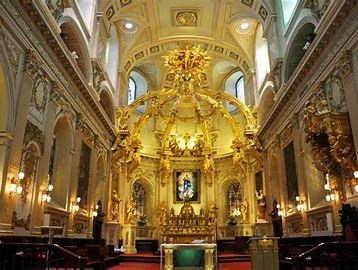
Have you ever been on a pilgrimage? Maybe you have traveled to the Holy Land, Rome, Lourdes, Our Lady of Guadalupe or some other Catholic site to increase your faith.
A basic definition of pilgrimage is a journey to sites of particular religious significance. Pilgrimage is a part of many of the great religions of the world, for in religion humanity seeks the answers to the perennial questions of life. Pilgrimage is a common human experience in which one seeks to fulfill a ritual obligation, live an experience of spirituality or ask for particular graces or miracles.
The Vatican II document, Lumen Gentium, speaks of the pilgrim Church that journeys toward the heavenly Jerusalem. In short, a pilgrimage is an outward journey of an inward movement toward God.
I am pleased to announce that our parish will be doing a fall pilgrimage to New York, Montreal and Quebec City on September 25th through October 1st. We will get to visit the shrines of the North American Martyrs, St. André Bessette, St. Kateri Tekakwitha, St. François de Laval and others. You get to experience the autumn foliage and French culture without having to endure jet-lag.
Please click below for more details about this wonderful opportunity to grow in your faith and fellowship with other parishioners. Space is limited so I encourage you to sign up soon. I look forward to having you join me on this spiritual journey this fall.
In His Mercy,
Fr. Eric Clark, Pastor
Click Here for More Information on the Pilgrimage